
Five Major Human Resources Trends in 2025: AI Reshapes Recruitment, Skills Training, and Global Talent Mobility
As the 2020s reach their midpoint, the human resources industry is shifting from crisis response to long-term planning. In 2025, AI will be deeply integrated into recruitment and employee services, skills training will be enhanced by technology, global talent mobility will accelerate, employees will need more support to navigate change, and remote work flexibility, though challenged, will not disappear. This article synthesizes insights from multiple experts to provide trend observations for HR practitioners.
The countdown has ended, the fireworks have faded, and the 2020s are officially halfway over. For HR professionals, this fact may be bittersweet—after all, the decade began with the massive shock of the COVID-19 pandemic.
Entering 2024, HR professionals had grown accustomed to change. While 2025 may be full of uncertainty, the new year also offers HR departments an opportunity to focus on shaping their long-term role—a chance that may not have been fully seized in previous years.
"Most companies we talk to feel they have moved past the 'firefighting' stage," said Brad Bell, professor of strategic human resources at Cornell University's School of Industrial and Labor Relations. "This allows companies to develop long-term plans and clarify HR's position within the organization."
The field is seeing many exciting developments, especially on the technology front, which creates room for HR growth. "My advice is to stay engaged, use these new developments to invest in yourself in 2025, and look for opportunities to upgrade your skills," said Jesse Meschuk, head of compensation consulting firm Exequity and former HR executive at Activision Blizzard.

1. AI's Next Act: Reshaping Talent Acquisition and Productivity
Artificial intelligence tops HR priorities this year. By some counts, most companies took steps to invest in AI in 2024, but Bell said the technology has now become the "main focus" for the year.
In the first wave of adoption, companies used AI for what Meschuk calls "frontline employee services"—chatbots handling self-service queries related to HR, finance, and more. The next step, he said, is integrating AI directly into talent acquisition, employee engagement, training, and sentiment analysis.
In recruiting, for example, AI will increasingly shape how recruiters and candidates engage. "You no longer need to search yourself," Meschuk said. "As a candidate, you receive job recommendations; as a company, you receive candidate recommendations."
He pointed to major companies like LinkedIn that have launched AI assistants as a sign of this trend. The Microsoft subsidiary announced in October its AI agent, Hiring Assistant, which can screen candidates and suggest screening questions. Meschuk said he has seen applicant tracking systems roll out similar products.
However, for many organizations, AI adoption is still in its early stages, said Megan Smith, head of HR for SAP North America. HR departments will be responsible for laying a solid foundation for implementation through governance models, templates, and other tools to prepare the workplace.
She added that employees will gain more self-service options through conversational AI, while HR departments will use AI for tasks ranging from generating interview questions to managing compensation cycles. "This is an opportunity for empowerment and multiplier effects, making many HR practices more efficient and valuable," Smith said.
Meanwhile, experts interviewed cautioned about the potential risks of over-reliance on AI. Meschuk called AI a practical recruiting tool "but not a panacea." "If you have diversity goals, trying to increase representation and expand to different experiences and skill sets, you should maintain that perspective regardless of the tools used." He advised HR teams to continue outreach programs for underrepresented groups and "not stop these programs just because AI tools exist."
Beyond recruiting, AI also poses risks to employees' daily work—from legal hurdles to PR issues. "Wise HR teams will educate employees on what constitutes acceptable use and how to use it responsibly," Meschuk said.
Smith said human decision-making should still dominate AI adoption. For example, if a department head uses AI to set next quarter's goals, they should still review the generated content and treat it as a starting point rather than an end-to-end solution.
The prospect of AI replacing workers persists, and HR teams may be affected even as the technology becomes more widespread. Bell mentioned that a CHRO he recently spoke with expects his organization's current 2,100 HR business partners and generalists to shrink to about 1,600 due to AI. "That's a significant change," Bell said. "We've received requests from many partner companies to upskill HR functions and HR business partners."
Additionally, vendor AI applications are proliferating. Bell said CHROs are "flooded by vendors trying to sell various products," making it harder for HR teams to determine which tools best fit their strategies. As a result, vendor management has become a more core skill for HR leaders. To help find the right AI tools, Smith advised HR leaders to adopt a people-centric approach and connect with peers facing similar challenges.

2. Skills Training Gets an AI Boost
Becky Cantieri, chief people officer at SurveyMonkey, said in an email to HR Dive that under the AI trend, upskilling and reskilling will be key to organizational success. She added that leaders should invest in learning programs that equip employees with AI proficiency while reinforcing human skills like creativity and emotional intelligence. "As we move deeper into the AI-driven era, the future of work will be defined by adaptability and continuous learning."
Smith said that due to the pace of change, new employees will increasingly need to match organizational skills. She noted that employers developing skills frameworks helps clarify the skills needed for specific roles. "Once established, employees can easily create personal learning plans," she said. "This trend will remain a major topic this year."
Bell said leadership and management training will also continue to be a focus of learning and development programs in 2025, especially given the disruptions managers have faced since the pandemic. He noted that companies are still catching up because the pandemic pushed training to the back burner. Additionally, virtual learning is likely to persist due to cost and scale efficiencies.

3. Talent Market Cools and Goes Global
The first half of the 2020s was filled with headlines about talent shortages and widespread employee unrest. The pandemic gave rise to the "Great Resignation," but as the market balance shifted toward employers, employees began craving stability.
Bell said employers should expect continued declines in talent turnover in 2025, though frontline roles in manufacturing and retail may be exceptions, as these sectors are still dealing with the aftermath of pandemic-era talent loss.
Meschuk said some industries are increasingly turning to global talent pools—a trend that may continue given persistent inflation. This is especially true in countries like Vietnam and Mexico, where more employers are offshoring service and support roles in areas such as finance, IT, and HR.
Trump's second term may bring tariffs and deportation policies that could affect companies' international operations. But Meschuk said looking elsewhere for talent "is sometimes necessary," especially in hard-to-find skill areas like data engineering, analytics, and AI.

4. Employees Need Help Navigating Change, Including Cultural Shifts
Facing emerging technologies, economic shifts, and a chaotic political environment, employees are experiencing significant turbulence at work. Cantieri said change is difficult for people and employers should pay attention. She cited a 2024 SurveyMonkey survey finding that 45% of employees reported an increase in workplace conflicts related to political and social identity.
Cantieri said HR professionals must navigate this tension carefully. This involves handling generational differences, especially regarding political discussions in the workplace: Gen Z employees are more likely to favor such discussions, which "may signal the beginning of a generational shift in workplace culture."
Meschuk said financial constraints can also trigger workplace conflict: managers face tighter budget limits than ever, further intensifying the skills shortage pressures on teams.
Meschuk suggested employers can rely on benefits programs to support employees and explore benefits delivery platforms that automatically recommend certain programs based on employees' specific life and career situations—a strategy increasingly mirroring employees' online user experience. For example, employees with children might receive information about 529 savings accounts, while those newly promoted to leadership roles could receive relevant training recommendations.
Bell said diversity, equity, and inclusion (DEI) programs faced numerous challenges in 2024, and HR teams may spend significant time deciding how to continue DEI work amid growing legal risks. "We see DEI in a wait-and-see state again, but there's also great interest among DEI leaders to come together, exchange ideas, and jointly find ways to navigate these changes," he added.
Smith said companies are striving to balance demonstrating strong values with remaining apolitical, and this balance may involve responding to specific legislative changes affecting their operations, whether directly or indirectly.
One example is pay transparency, a growing national movement adopted by more than a dozen jurisdictions across the country. HR teams can take various approaches to ensure transparency and fairness, but Smith advised HR professionals to leverage their networks to learn how peers are handling these hot-button issues. "Don't go it alone," Smith said. "My observation is that when HR leaders come together to share common challenges and successes, the value is immense."

5. Flexibility Won't Disappear Despite Giants Mandating RTO
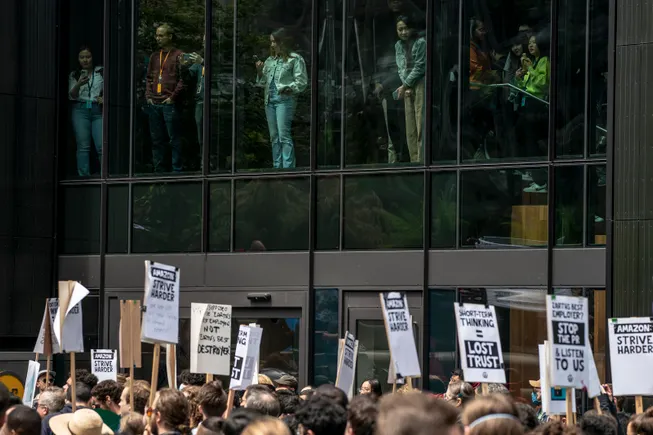
Observers had expected a wave of return-to-office mandates in 2024, and corporate giants in the U.S. did deliver. Amazon is perhaps the most emblematic example; its five-day RTO requirement sparked strong employee backlash, with one poll showing 73% of surveyed Amazon employees considering leaving due to the policy.
This backlash exists across the broader workforce. For example, a Resume Builder report from October 2024 found that one in five U.S. workers ignores employer RTO mandates. Bell said that despite actions by companies like Amazon, employers may struggle to end flexibility; however, adjustments to existing hybrid policies—such as slightly increasing the number of days employees must be on-site—may be on the table.
Meschuk offered a different perspective, saying employers are less open to flexible work than expected compared to the pandemic peak. Beyond productivity concerns, employers may also worry about the difficulties experienced by teams that don't work together.
Related research shows that while many employees prefer flexible work options, they also understand the importance of in-person work. Employers can seek models that accommodate both. For example, SAP has a three-day-per-week office requirement that includes client activities, travel, and other business-related time out of the office, Smith said—and the employer expects to maintain hybrid operations in 2025. "For us, we see this as a continuation," Smith said. "We believe staying connected is critical, but we also believe people need flexibility."