
How two women found their voice in a male-dominated industry
In the timber supply industry, María García Osés and Freya Hannah tell the story of how they overcame gender barriers, gained confidence, and found their professional voice. The article explores the impact of mentorship, learning and development programs, managerial support, and workplace bias on women's career advancement.
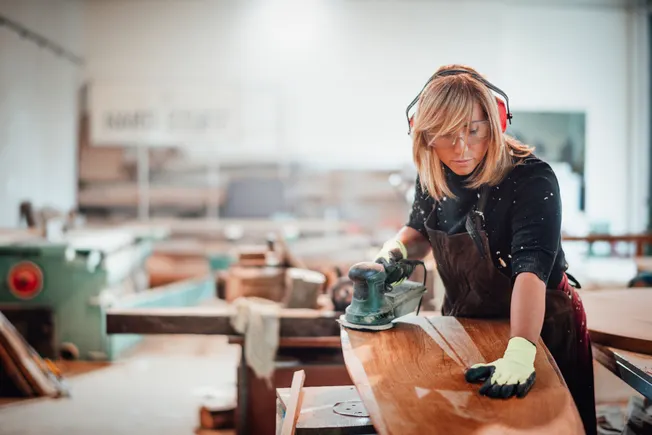
Many companies that promote diversity, equity, and inclusion (DEI) initiatives emphasize the importance of embracing employee differences. But what about employers who try to treat every employee the same?
María García Osés is the business control manager at wood supplier Garnica, where she has worked at the company's headquarters in Spain for nearly four years. She says, "This is a company where I feel there are no differences between men and women. From the start, you develop entirely based on your performance and skills." She believes this environment developed naturally because the company focuses on culture rather than quotas. "It's not about convincing or forcing anything," she says, "If you have great talent and high performers, they will naturally grow."
She adds, "I think it's important not to try to say 'you need to have X number of women in this position, so we know that 40% of management positions are held by women.'" Garnica does not achieve its workplace environment by setting representation targets.
So, how does Garnica achieve inclusion and equity?
How mentoring can help women climb the ladder
Research shows that women, especially women of color, can benefit from targeted learning and development programs. A report released by DeVry University in September 2023 noted that only 56% of women have access to upskilling opportunities, compared to 73% of men. The report also highlighted a gap between employers' intentions and actual actions regarding employee training.
Similarly, a report from DDI this month points out that women are hindered in advancing to leadership due to a lack of career development opportunities.
García Osés told HR Dive that she was initially hesitant about a program aimed at female leaders. Despite its international participation and reputation, she was unsure whether a program specifically for women was appropriate. "At first I didn't think it was a good thing, because I thought it would be better to have a gender mix," she says. But through the program, she realized that women often have some innate skills and some areas for improvement, "which is entirely based on our experiences and the roles we typically play in society."

Part of this experience involved embracing "soft skills"—and gaining confidence through that awareness. "You can bring these to the table: how we organize, how we plan, how we resolve conflicts," she says, "And then we can play a very important role."
After completing the program, García Osés found its structure helpful. "They made me realize how strong I am in certain areas, which I had previously taken for granted." She was then able to reposition these strengths in her work at Garnica. "You truly feel more empowered because you believe in yourself more," she reflects.
Learning and development is only part of the puzzle
García Osés says that working at a company that "gives you a voice and visibility," combined with learning and development opportunities, helps. She says the respect from colleagues goes hand in hand with "being the best version of yourself," and "honestly, I have never seen this anywhere else."
But helping women succeed in male-dominated fields goes beyond learning and development. HR experts say cultural issues also need to be addressed.
As many studies have highlighted, the workplace is full of microaggressions against employees with marginalized identities. For many women, this manifests as being interrupted while speaking, or colleagues mistakenly assuming they are more junior. Women often report being afraid to propose ideas at work or speak up in meetings.
Sometimes, the HR solution is not sending employees to learning and development programs, but educating managers on how to be good allies.
Freya Hannah, Garnica's representative in Canada, attributes her workplace growth to her boss, David Smith, President of Garnica North America. "As a Canadian—and maybe as a woman, I'm not quite sure—but I tend to say 'I'm sorry,' almost apologizing for my ideas, and I would even 'sneak up' to him and say, 'I have an idea.'"

Hannah recalls that Smith told her he didn't want her to do that; instead, she remembers him saying: "If you have an idea, stand your ground, look me in the eye and say: 'I have an idea, and I think it will work because... and this is what I'm going to do.'"
"He said, 'Freya, I know you're going to break the rules. Everyone knows you're tough, you've fought your way out there. I just want you to know, think it through before you break them. That's all,'" she says. As long as she could explain why she wanted to break the status quo, he could understand and support her.
"This is an experience I've never had before," she says.
How gender affects the leadership pipeline
Across industries and levels, women often face difficulties in career advancement. Notably, according to Lean In's annual "Women in the Workplace" report, from 2015 to 2023, women's representation in the C-suite increased from 17% to 28%. There are also more women in vice president and senior vice president roles.
"These hard-won gains are encouraging, but also fragile," the researchers say, "Women's progress at the manager and director levels has been slower, resulting in a weak middle of the pipeline that affects the majority of women in corporate America."
For women of color, the gap is even larger: among C-suite leaders, 1 in 4 is a woman, while only 1 in 16 is a woman of color.
Lean In believes this "broken rung" hinders women more than the glass ceiling. "It's that first critical step from entry-level to manager, and we find it's the biggest obstacle on women's path to senior leadership," Caroline Fairchild, editor-in-chief and vice president of education at Lean In, told HR Dive.
The gender ratio at the manager level is 60/40, favoring men. Additionally, for every 100 men promoted to manager, only 54 Black women are promoted. (The promotion rate for Black women was higher in 2020 and 2021, but has since fallen below 2019 levels.)
"There are many outdated ideas often used to explain why women aren't promoted at the same rate as their male counterparts," Fairchild says, pointing to myths such as women not asking for promotions as frequently as men, or women having higher overall turnover rates.
"But neither of these is true. Women at the entry-level and manager levels ask for promotions just as often as men—and women at these levels are not more likely to leave the company than men. So this really points to a major driver of the 'broken rung,'" Fairchild says, "and that is bias."
How does bias affect the leadership talent pipeline? "Men are promoted based on potential, while women are often promoted based on past achievements. Bias is driving these numbers," Fairchild says, adding that these figures should serve as a call to action for senior leaders, "not only to identify the 'broken rung' in their own ranks, but also to find solutions."
One solution Fairchild proposes is sending bias reminders before recruitment rounds and performance reviews. "Research shows that anti-bias training and awareness fade over time. So, at cyclical moments in the calendar year—such as performance review periods or peak hiring seasons—remind employees to be aware of bias and how it might manifest."
Celebrating the value women bring
Fairchild says employers can support women in male-dominated industries such as STEM, construction, and manufacturing by addressing the "broken rung" in the career ladder.
The talent pipeline may also need examination. "I often encourage women to enter this industry," Hannah says, "The forestry industry is very interesting."
Previously, she worked in aeromedical evacuation, handling medical repatriations: "White-collar work, with constant high pressure. I always say I love this industry because no one dies. They might just not get their kitchen before Christmas, maybe," she says.
She says that in male-dominated industries like manufacturing, women can bring particular value. Due to differences in gender socialization, their communication styles may differ. "I do think that sometimes having women in these relationships is an advantage," she says, noting that different people "bring different things to the table."
And a woman in the wood supply industry knows best what women can bring to the "table."