
The Tension Between Retailers' Union Attitudes and Their ESG Commitments
A decade ago, the collapse of the Rana Plaza building in Bangladesh prompted the retail industry to focus on labor rights, with ESG reports gradually becoming a key basis for investor assessments. However, experts point out that many US retailers' actual practices on issues such as collective bargaining contradict their ESG statements, a contradiction that has become increasingly prominent with the resurgence of the labor movement. This article examines cases such as Amazon and Target to dissect the conflict between corporate human rights commitments and anti-union positions, and explores shifts in investor and consumer attitudes.
Ten years ago, the collapse of an eight-story factory building in Rana Plaza, Bangladesh, killed more than 1,100 people. Workers had noticed cracks in the building weeks earlier and begged management not to make them enter, but to no avail. Once the building began to give way, it collapsed completely in less than 90 seconds. Union leaders called the event "mass industrial murder," and it exposed problems with fair labor practices and drove many changes in the retail industry. Global organizations took action to develop safer working standards, and workplace resolutions now often appear in retailers' ESG reports, which are increasingly important to investors and other stakeholders.
Experts say a growing number of consumers and investors are beginning to believe that the policies of some U.S. retailers on issues such as collective bargaining contradict their ESG rhetoric, especially when workers try to form unions. As the U.S. labor movement revives, this contradiction could become more apparent, and more companies will find it harder to justify themselves, according to Alison Taylor, executive director of the Ethical Systems program at NYU Stern School of Business.
Amazon is just one example. Its stated human rights principles, including support for workers' collective action, conflict with its treatment of labor organizers and its listing of unions as a potential business risk in investor materials. At a recent shareholder meeting, the e-commerce giant considered several proposals favorable to its hourly workers, but only after the U.S. Securities and Exchange Commission ruled that the proposals could not be omitted from its proxy statement.
"As we have always said, our employees have the right to choose whether or not to join a union. They have always had this right," Amazon spokesperson Kelly Nantel said in an emailed statement. "As a company, we don't believe unions are the best answer for our employees. Our focus remains on working directly with our team to continue making Amazon a great place to work." Nantel did not immediately respond to questions about why the company, while explicitly supporting international labor standards that include collective bargaining, also views it as a factor that hinders its relationship with employees or its ability to create a good workplace.
"ESG is largely about win-win thinking, but unions are an area where companies still believe the only possible outcome is win-lose," NYU's Taylor said in an email. "This knee-jerk reaction is disappointing because the rights to speak, protest, and organize are fundamental civil rights, and many of these companies have also made human rights commitments."
David Schilling, senior advisor at the Interfaith Center on Corporate Responsibility, believes there are many contradictions between what many retailers say in their ESG reports and how they treat their own workers. "Freedom of association and collective bargaining—these are fundamental human rights," he said in a phone call. "The good news is that companies and investors have increased awareness of fully engaging with human rights responsibilities."
Supporting workers' rights, but opposing unions?
In recent years, several major U.S. retail chains have raised starting pay, improved benefits such as healthcare and family leave, and offered more opportunities for advancement or education. Economists typically view such policy changes as the result of market forces, such as low unemployment, although retailers tend to portray them as worker-friendly.
For example, when Target announced in February that it would set new starting pay ranges of $15 to $24 per hour at its stores, supply chain facilities, and corporate offices, Chief Human Resources Officer Melissa Kremer said the company wants "all team members to live better because they work at Target." "Our team is at the center of our strategy and success, and their energy and resilience keep us at the forefront of meeting our guests' ever-changing needs year after year," Kremer said in a statement. "We continually listen to our team members to understand what matters most to them, and then use that feedback to invest in ways that meet their needs at different stages of their careers and lives."
Would a retailer so committed to listening to its employees support their collective action? On paper, it seems so. Target recognizes the International Labour Organization's core conventions in its ESG report, which include workers' rights to organize and bargain collectively. "We are committed to respecting human rights throughout our operations," the company says in the "Social" section of the report.
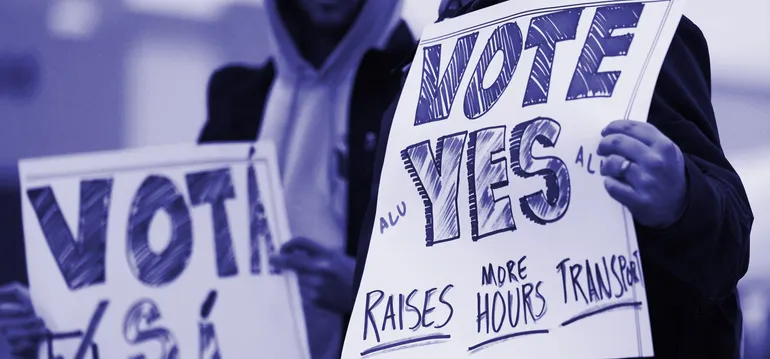
However, when workers at a Target store in Christiansburg, Virginia, launched a unionization campaign, a company spokesperson declined to say whether the company supported the effort. According to filings with the National Labor Relations Board, the group "Target Workers United" has since withdrawn its petition to formally gain union recognition. The workers' action stemmed from a failed request for a new policy for long-term employees (who still earn near the starting wage of $16 per hour at that store), according to a screenshot of demands shared on Twitter. According to MIT's living wage calculator for the Christiansburg area, this wage is below the living wage for a single adult without children. Target declined to confirm the wage or explain how it determines pay at specific stores, and did not immediately respond to questions about its stance on unionization.
Retailers including Amazon and REI have been more explicit than Target in opposing unionization at their sites, saying it interferes with their relationship with employees. Like Target, Amazon says the ILO Declaration on Fundamental Principles and Rights at Work guides its own human rights approach. These principles include "freedom of association and the effective recognition of the right to collective bargaining." Company management believes that having good communication with workers is not enough to meet this level, said ICCR's Schilling. "The problem is that management says, 'We know what's best for workers,'" he said. "They won't engage in truly enforceable dialogue—it's voluntary. That's not enough."
New labor activism
Other retail workers are persisting in their pursuit of union status, part of what many labor experts see as a wave of "new labor activism." Experts say the reasons for the revival of U.S. labor activity are varied, involving not only wages but also quality-of-life issues, all of which were highlighted by the pandemic. The movement has also been supported by the National Labor Relations Board, which is widely seen as having gained new power under the Biden administration.
At the height of the COVID-19 pandemic, store and warehouse workers were labeled "essential," but many were critical of safety measures and a lack of transparency in their workplaces. Now, especially as hazard pay has become a thing of the past at most retailers, more workers are demanding better pay and working conditions. This has led to multiple union efforts, sometimes even successful—even at Amazon.
The visibility of workers' struggles, employers' responses, and other company policies contrast sharply with many of the ideals advocated in ESG communications, said NYU's Taylor. "I do think there is tension if you claim to support ESG while opposing unions, not paying living wages, and not paying your fair share of taxes," she said. "A truly progressive approach would allow such organizing, or even emulate the German model of having workers on the board." According to ICCR, at Amazon's shareholder meeting in May, a proposal to include hourly workers on the board received 22% of shareholder votes.
Schilling noted that shareholders' rising interest in these issues stems not only from concern for human rights, but also from a growing recognition that organized labor offers opportunities for stable business. This is already a reality for European investors, where unions are more common and collective bargaining is routine. "Once you have a formal agreement with labor, it can benefit you," he said. "You go through a negotiation process, so there is fairness between the company and employees. In the U.S., this is still seen as a business risk, rather than a potential way to build sustainability—not only for corporate profits, but also for other affected stakeholders, whether in its own operations or its supply chain."
Social issues also matter to consumers, especially Gen Z, according to McKinsey's latest Consumer Pulse report. More than two-thirds of young consumers say at least one ESG issue is important to them, even at a time when inflation is straining household budgets and value is also a concern. "What they care about most is that companies are transparent and show care for people—employees, customers, and others in the community," McKinsey researchers said. Similarly, Barclays recently published a client report noting that consumer attitudes toward ESG are becoming "truly multifaceted." "Retailers need to think very seriously about ESG because it now affects their business more broadly," the firm said. "To date, the driving force has been concentrated on environmental considerations, but recently it has begun to increasingly encompass social and governance aspects. In this context, it is certainly better for retailers to take the 'carrot' option, integrating ESG into their culture, rather than waiting to be hit by the 'stick' of ESG and risking losing future relevance."
In other words, U.S. companies may have to do more to reconcile their ESG goals with internal realities, said NYU's Taylor. "I am fairly certain that the rise of employee voice is not going away," she said. "Companies can choose to fight it with everything they have, or accept it and try to succeed in this new world. This is just the beginning of the story."
