
Labor challenges persist, retail accelerates adoption of automation
Labor shortages are forcing food retailers to rethink their operational models, accelerating the application of automation technologies. From self-checkout to smart shopping carts, retailers are enhancing efficiency while also weighing the role of human employees and customer experience.
This article is the third in a series covering key trends affecting grocers in 2022.
In response to ongoing labor shortages—which have severely tested retailers' ability to keep stores staffed and shelves stocked—grocers are increasingly turning to mechanization for a range of tasks historically handled by humans.
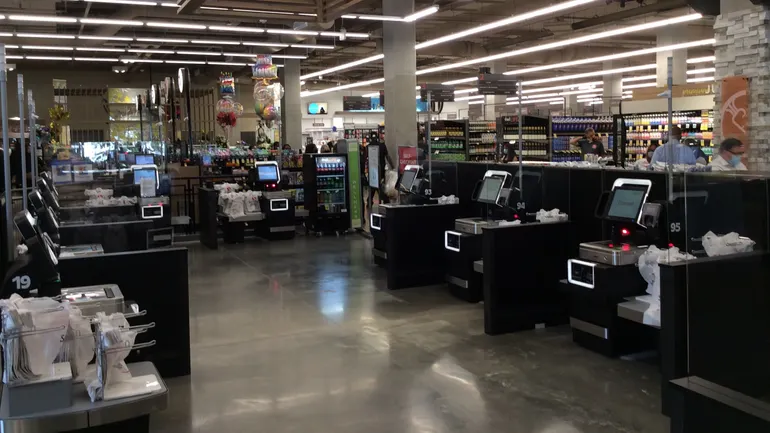
This includes adding more self-checkout terminals in stores and relying on automated tools that help update prices and manage inventory. Many of these tools have long been available to food retailers, and now, as the industry faces seemingly long-term hiring and retention challenges, they are receiving more attention.
However, industry experts say that as retailers increase their reliance on time-tested automation solutions, they are also grappling with pressing questions about the role of human workers in the supermarket of the future.
Gautham Vadakkepatt, director of the Center for Retail Transformation at George Mason University's School of Business, noted that having employees perform tasks easily replaceable by technology may not be the best use of human time. "Companies are getting smarter, and considering the new environment we operate in, they say, 'Let's use automation for these things and deploy our talent to roles that truly add value to the company,'" he said.
Vadakkepatt said automation may save retailers costs and speed up customer checkout, but human workers still play a key role in ensuring the shopping experience is satisfying for customers. "Humans are naturally good at handling problems and solving issues, and that's where we will see humans deployed," he said.
"I think the labor shortage is pushing us into the future, and grocers are smartly viewing this as a growth opportunity."

Henry Michaelson
Co-founder, President, and CTO of Halla
Retailers' balancing act
The challenges retailers face in hiring and retaining people are providing grocers with a compelling reason to embrace technology they might not have adopted in the past, said Henry Michaelson, co-founder, president, and CTO of Halla, which provides personalization technology to retailers.
"I think the labor shortage is pushing us into the future, and grocers are smartly viewing this as a growth opportunity," Michaelson said.
Neil Stern, CEO of West Coast supermarket chain Good Food Holdings, said retailers are facing a complex balancing act as they respond to the industry's labor crisis. "We have physical stores, we have customers coming in, we have shelves that need restocking. In the current very challenging environment caused by the pandemic, I still need employees to show up," he said. Good Food, which operates brands such as Bristol Farms, Metropolitan Market, and New Seasons Market, runs about 50 supermarkets.

Stern said Good Food is significantly increasing its use of technology to keep operations running, with self-checkout being a particular focus for the company as it helps speed up customer flow. "It's not just an opportunity for retailers to save labor at the front end; it's actually the checkout method customers prefer," he said. Stern noted that Good Food staffs one employee to monitor every four self-checkout units.
A survey conducted by mobile data company Anyline in December showed that more than three-quarters of consumers said they would be more likely to shop at a store if it offered scan-and-go checkout technology. Anyline co-founder and CEO Lukas Kinigadner said the company is developing technology that allows customers using scan-and-go systems to purchase age-restricted products like alcohol without interacting with store staff.
Stern said customers are increasingly interested in getting in and out of stores quickly, which in many cases has led people to value automation more when visiting Good Food stores. This focus is especially evident at food service counters, where customers sometimes have to wait for service, so Good Food is installing self-order kiosks for sandwiches to speed up the process.
"You could say 'how wonderful is the interaction we provide,' but customers are also saying 'there must be a better way. If I want a sandwich, I'll order through an app or kiosk and just pick it up,'" Stern said.
According to Stern, Good Food will also test smart shopping carts this year in some stores in partnership with Veeve, a technology that uses computer vision to automatically record items as customers take them off shelves. The retailer also plans to pilot electronic shelf labels in 2022.
Stern said that while electronic shelf labels can save on labor costs because they require less maintenance, that alone is not enough to provide a substantial return on investment. But when digital price displays are used to support dynamic pricing, their appeal increases significantly. "That's an important use case many retailers will be looking at," he said.
Stern also said Good Food is researching technologies like shelf-scanning robots from Simbe Robotics to automate inventory tracking in stores, but has not yet decided whether to move forward.
Wholesalers that have faced hiring and retention difficulties during the pandemic are also embracing automation in more areas, said Marco Di Marino, director in the retail and grocery division of consulting firm AlixPartners. He cited robots that efficiently build product pallets before they are loaded onto trucks for shipping. "When robots put products on pallets, they do it better," Di Marino said.

The challenging labor market is also prompting retailers to seek ways to improve the efficiency of their e-commerce operations, especially order fulfillment speed, said Neil Moses, CEO of Wynshop, which provides e-commerce technology to retailers, in emailed comments. Moses said that in a 2021 study Wynshop conducted with research firm Incisiv, nearly 80% of participating grocers listed "improving picking efficiency" as a primary way to boost profitability.
Mike LaVitola, co-founder and CEO of convenience store chain Foxtrot, said he is looking for technology to handle repetitive tasks like checkout to enhance the company's ability to offer differentiated products. Foxtrot is investing heavily in technology, including testing computer vision-based frictionless checkout in several stores to enhance capabilities like inventory management and personalization. LaVitola wants Foxtrot employees to focus as much as possible on product curation, which includes a wide range of locally sourced and private-label products.
"Think about our stores—every product on the shelf has been tested and debated... That means there's a story behind all these products. That's really what we want our store teams to focus on," LaVitola said.
Understanding the limits of technology
Although rapidly rising labor costs combined with rapid advances in areas like artificial intelligence and computer vision have created ripe conditions for retailers to embrace innovation, they have also raised questions about the appropriate level of automation for grocers, said Saibal Ray, academic director of the Bensadoun School of Retail Management at McGill University in Canada.
"From an economic standpoint, more automation to some degree will increasingly make sense," Ray said, as technology costs decline and retailers have to raise pay to attract and retain employees. At the same time, self-checkout terminals, smartphone-based ordering facilities, and technology that automatically records purchases may introduce obstacles that frustrate customers even as retailers try to eliminate shopping friction.
For example, requiring people to download an app or set up an account to make a purchase could reduce shopping convenience and potentially drive customers away. Additionally, self-checkout systems, while beneficial to retailers, may also annoy customers who are asked to take on the work of store employees. "Consumers are doing the work of store employees at self-checkout, and they ask, 'What do I get out of this? Do I get a price discount?'" Ray added.

LaVitola also agreed that going too far down the technology path could undermine the consumer retail experience. "We have to be very careful not to just pile on a bunch of technology... but to make technology recede into the background and create a better experience for employees and customers," he said.
Beyond helping retailers manage operations with fewer employees, technology can also attract potential employees by adding excitement to retail jobs, said David Gottlieb, chief revenue officer of Trax, a company that provides computer vision services to retailers. "When considering these next-generation technologies, there's certainly an opportunity to bring benefits not just to the entire store—because of lower costs and improved product availability—but also to employees and their retention, because now you've given them a cool technology tool," Gottlieb said.
Jeff Wells contributed to this article.