
Resume gaps become an automatic deduction in job hunting; how do returnships build a bridge back to the workplace?
A resume gap can reduce a job seeker's chances of getting an interview by 45%. In response to this widespread implicit bias, companies such as Zoox, PepsiCo, and Schneider Electric are partnering with nonprofits like Path Forward and reacHIRE to launch returnships aimed at caregivers. This article tracks the real experiences of several participants, revealing how these programs provide a pathway back to work for experienced professionals who have temporarily left the workforce, while helping companies alleviate talent shortages and advance diversity goals.
Editor's note:This article is the second in a series on how companies can reach non-traditional talent.
Juana Rudati once served as a department head at the U.S. Department of Defense's San Francisco office. Six years ago, after that job ended, she left full-time work entirely.
"I spent a long time looking for a job, almost the entire time I was away. But then, life threw a curveball," Rudati said.
Her mother suffered a sudden heart attack, and she needed to travel to Florida to care for her; at the same time, during the early days of the COVID-19 pandemic, her children needed to attend school remotely from home.
Over the years, she took on some part-time work, including serving as an adjunct physics professor at Diablo Valley College in Pleasant Hill, California, and doing grant writing. But she never fully returned to the workforce, nor was she willing to settle for a job that wasn't the right fit.
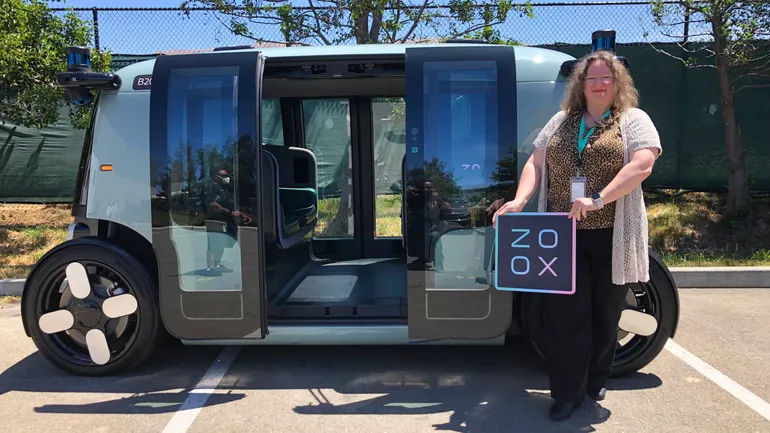
Last year, as her mother moved into an assisted living facility and her children returned to school, Rudati applied for and was accepted into a "returnship program" offered by Zoox, an autonomous taxi developer owned by Amazon, and operated by the nonprofit Path Forward. Path Forward works with companies to provide transition programs for caregivers returning to the workforce.
"Now I can go back to work, and I really do enjoy working," Rudati said.
Rudati was one of seven participants in Zoox's first returnship cohort. After completing the 16-week program, she was hired full-time by Zoox last April. Now, she works as a technical program manager, responsible for ensuring the safety of the company's robot platform.
"This job is doing things on the edge of possibility, which is what I'm used to. I'm used to doing things that no one has ever done, or even things that some thought were impossible," Rudati said.
Despite her background as a scientist and researcher, Rudati said that before encountering Zoox, she truly felt the "unconscious bias" that recruiters and hiring managers might hold toward "returners." Zoox, in contrast, is a company actively embracing those returning to work after a career break.
"We're not interns, and we're not new graduates," Rudati said. "If you look at my LinkedIn profile, it's actually quite impressive. But people just don't see it, as if it doesn't exist."
Bridging the resume gap
People involved in these programs say returnships help companies find experienced candidates to fill mid-level positions that aren't suitable for new graduates. These candidates, with their prior work experience, ramp up faster and require less time and training cost; they also help companies make progress on diversity goals.
Returnships can also help job seekers overcome "resume gap bias." According to a 2019 study by ResumeGo, a resume-writing service, job seekers with gaps on their resumes were 45% less likely to get an interview. The study submitted over 35,000 fictional resumes to job postings on platforms like ZipRecruiter, Indeed, and Glassdoor. The results showed that compared to job seekers with a two-year gap, those with a three-year gap received 53% fewer callbacks.
"The biggest challenge I faced was the blank space on my resume. Even though I polished my LinkedIn profile repeatedly and pursued every interview opportunity, I kept hearing the same thing from recruiters: overqualified and lacking recent work experience," Ellen Chamberlain, a sales and strategy analyst for PepsiCo's Southern Division, told HR Dive via email. She participated in the company's pilot returnship program last year.
Heather Hoytink, president of PepsiCo's Southern Division, oversees the returnship program. She said that at the end of the 16-week program run in partnership with Path Forward, 80% of participants, including Chamberlain, accepted full-time positions at PepsiCo. The company is currently running its second cohort, which has doubled in size.

Building an on-ramp back to work
"People don't forget what they learned in their careers just because they stepped away temporarily," said Christine Winston, executive director of Path Forward. "But there are very few on-ramps back to work."
She noted that most returnships last several months and require applicants to have a certain level of prior professional experience. Companies set aside open positions for participants to move into after completing the program.
"These programs are for people who are excluded by bias from the current interview and hiring process," Winston said. "A gap on a resume often causes recruiters or hiring systems to set an application aside. For job seekers, a gap is an automatic 'deduction.'"
Venus Senjam had sent out resumes to countless companies over six months before finding reacHIRE, another organization that helps companies hire returners.
"My resume had a gap of nearly ten years," Senjam said. "There was no way I could find a job through conventional means."
She had served in the Indian Army Corps of Engineers before her family relocated from India when her husband got a job opportunity in the U.S. She chose to stay home to raise their children, who are now in middle and high school.
"I felt it was time to return to the workforce," she said. But the application process left her emotionally drained. "Every time you submit and hear nothing back, your morale and confidence drop."
In reacHIRE's returnship program, she said she cried alongside other returners. "There's so much emotion in it," Senjam said. "It's about everything we've been through to get a job."

She said the program rebuilt her confidence and prepared her mentally for returning to work. Now, she is a senior customer program manager at Schneider Electric. Senjam was among the first cohort of returners at Schneider Electric, 70% of whom were hired by the company.
"We decided to try and pilot this in the field because, like many large companies, we were facing increasing open positions. Our progress on diversity initiatives was quite slow, and we truly lacked qualified and diverse talent," said Christie Lee, HR business partner and returnship program lead at Schneider Electric.
The company is currently running its second cohort, which has doubled in size from the 2022 pilot. Lee said the company plans to further expand the six-month returnship program next year.
"Our goal is not just to provide a six-month experience, but to convert these returners into full-time employees," Lee said. "Participants like Venus can quickly upskill and be effective in their roles. After six months, their learning and performance even surpass that of new hires. Compared to new graduates who may need extensive training, the return on this investment is worthwhile."
Returners are paired with mentors, and managers receive training on how to provide support.
"Even if I didn't understand 75% of things at first, I never felt overlooked," Senjam said. "I had a very supportive team."