
Is the NDA About to Exit the Stage? Signals from Congress and Multiple States' Legislation
Recent legislative developments in the U.S. Congress and multiple states indicate that confidentiality agreements (NDAs) and mandatory arbitration clauses in sexual assault and sexual harassment cases are facing unprecedented restrictions. This article reviews the progress of relevant bills, corporate responses, and expert opinions.
Is the non-disclosure agreement (NDA) coming to an end? Legislative actions by the U.S. Congress and multiple states suggest this possibility is growing—and mandatory arbitration clauses may also be restricted along with it.
On September 29, about two weeks before the fifth anniversary of the #MeToo movement, the U.S. Senate passed the SPEAK Out Act, which would overturn confidentiality and non-disparagement agreements in cases of sexual assault and sexual harassment. The bill was introduced by Democratic Senator Kirsten Gillibrand of New York and co-sponsored by bipartisan lawmakers including Republican Senator Lindsey Graham of South Carolina and Democratic Senator Amy Klobuchar of Minnesota, passing by unanimous consent. The bill now awaits consideration in the House of Representatives.
Although bipartisan cooperation was rare in 2022, the SPEAK Out Act is already the second employment-related bill to receive such support in Congress this year. In February, lawmakers passed the Ending Forced Arbitration of Sexual Assault and Sexual Harassment Act (the #MeToo bill), which invalidates mandatory arbitration agreements that employees sign when filing sexual assault or sexual harassment claims, allowing them to go to court.
What brought about this bipartisan cooperation? Aaron Goldstein, a partner at Dorsey & Whitney, told HR Dive: "I don't think anyone is going to stand on Harvey Weinstein's side. Everyone is on the same page."
Goldstein noted that the actions on arbitration and NDAs come at a unique political moment: Republicans are no longer always seen as advocates for corporate interests, and Democrats are not always on the opposite side.
In recent years, many companies have taken activist-leaning initiatives, from setting diversity hiring goals to offering abortion travel benefits after the Dobbs v. Jackson Women's Health Organization ruling. Combined with debates over COVID-19 and vaccinations, Goldstein believes Republicans have developed an "anti-corporate tendency." This may have created conditions for more actions restricting corporate power—even on issues typically embraced by the left.
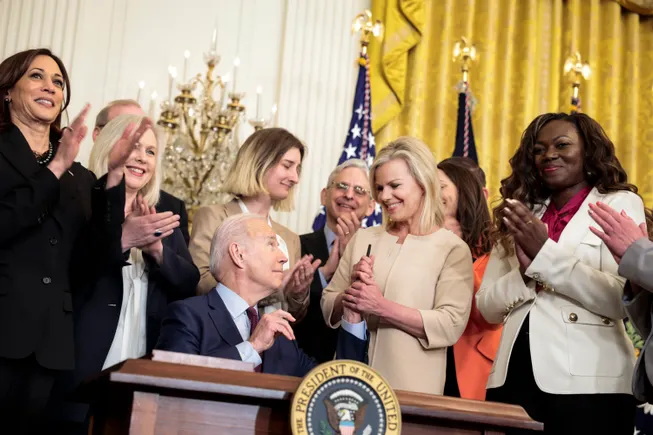
Former Fox News host Gretchen Carlson, a familiar face to many Republicans, becoming a leading advocate on this issue may also have helped. Carlson co-founded the nonprofit advocacy initiative Lift Our Voices with former colleague Julie Roginsky and journalist Diana Falzone, dedicated to ending forced arbitration and NDAs. The organization played a key role in pushing the February #MeToo bill (Carlson attended the signing ceremony) and the recent Senate passage of the SPEAK Out Act.
Last night, the Senate passed the bipartisan #SpeakOutAct to prevent survivors from being silenced by NDAs due to workplace abuse. We thank our Senate partners @gillibrandny, @MarshaBlackburn, @maziehirono, @LindseyGrahamSC, and supporters in both chambers.https://t.co/RgBgcOI5Fe
— Lift Our Voices (@LiftOurVoicesUS) September 30, 2022
Expanding the issue
Although sexual assault and sexual harassment may be the first frontier for overturning NDAs and forced arbitration agreements, Lift Our Voices and its advocacy partners do not intend to stop there.
"While our personal experiences involve workplace harassment, our organization is fighting for all toxic workplace issues for all protected groups," Carlson said during a September 16 online event with the executive membership organization Athena Alliance. "So, anything under Title VII of the Civil Rights Act of 1964—any form of discrimination, whether age, disability, race, sex, LGBTQ+, etc., we are fighting for all these disenfranchised groups, and we have a lot of work to do."
Coco Brown, CEO and founder of Athena Alliance, said the organization is working to build connections and provide visibility for Carlson and Lift Our Voices. Brown told HR Dive: "These women are able to take on the responsibility and say, 'We're actually going to implement this policy in our business'... so that she can have more and more reference points, saying 'That company is doing it, this company is doing it, and this company is doing it too.'"
With NDAs and forced arbitration potentially becoming invalid for sexual assault and sexual harassment claims, the focus may shift to other protected groups, as Carlson suggested. During the September 16 event, Carlson and Roginsky pointed out differences among various workers under such agreements and procedures. Roginsky stated that nearly 60% of Black workers are subject to forced arbitration, and 65% of workers earning minimum wage or slightly above are subject to forced arbitration.
Roginsky said home healthcare is the industry with the highest number of forced arbitration clauses. "So, if you think about the average person we're fighting for... she's a Black woman, making $13 an hour or less, cleaning bedpans."
For Lift Our Voices, the legislative strategy is to "take small steps," Carlson said. In speaking with HR Dive, Brown noted that when an issue is too all-encompassing, gaining bipartisan support is difficult. She explained: "Unfortunately, sometimes the system can only handle one thing at a time. You try to cram too much in at once, and the whole thing gets voted down."
The gradual dismantling of NDAs
In Goldstein's view, although arbitration and NDAs are often lumped together, the former sometimes has merits—especially when employees want to maintain privacy—while the latter is increasingly difficult to defend. He said: "Since #MeToo started in 2016, 2017, I've been advising clients not to require NDAs. Because this kind of information will come out anyway, and once it does, the consequences are devastating."
Goldstein emphasized that companies need to worry not only about legal issues—public relations also plays a major role in corporate success. "Litigation risk won't kill you," he said, "What kills you is if your company becomes a trending hashtag, seen as a disgusting company that hires predators, regardless of the facts... Once there's a cover-up, there's a presumption of guilt."
Many companies may have received similar advice and have relaxed or completely eliminated NDAs. Media company Condé Nast abandoned the use of such tools in discrimination and harassment claims in 2020. Microsoft announced a similar move in June. The company wrote in a blog post: "Microsoft has received feedback that we can further strengthen our workplace culture and encourage employees to raise workplace concerns by addressing... confidentiality clause issues."
But such moves cannot be attributed solely to corporate altruism or lawyers' foresight; Condé Nast appears to have responded in part to internal union pressure. And Microsoft is headquartered in Washington state, which passed the Silenced No More Act in March—legislation that prohibits NDAs in various circumstances and took effect the day before Microsoft's blog post.
In addition to Washington state, several other states have passed laws restricting or prohibiting the use of NDAs. California has its own Silenced No More Act, which took effect on January 1. Maine and Oregon also have such laws, as does Hawaii. For many companies, especially tech companies, state laws are preemptively replacing their voluntary decisions to shed their confidentiality armor.
"More favorable in court"
Although NDAs may be heading toward extinction, many companies still favor forced arbitration agreements. Goldstein said: "I think you'll see resistance to completely abolishing arbitration agreements." The appeal of such agreements largely lies in the fact that employees are typically required to waive their right to participate in class-action lawsuits—a right the U.S. Supreme Court upheld in 2011AT&T Mobility LLC v. Concepcioncase ruling.
Class-action waiver clauses help protect companies from potential lawsuits by dissatisfied employees. "For many plaintiff lawyers, taking on 5,000 cases of $150 each doesn't make sense," Goldstein said.
On the other hand, he noted there are exceptions to the utility of waiver clauses. In 2020, DoorDash experienced a painful backlash to its strategy when a judge ruled the company must arbitrate with more than 5,000 workers who claimed they were misclassified as independent contractors—at a cost of $1,900 per case.
Like NDAs, Goldstein advises employers to cool their enthusiasm for arbitration—both for the sake of employees and their own interests. "Arbitration agreements... are actually not favorable to employers, at least not as favorable as most employers think," he said. "Often, you're better off in court because arbitrators don't like to dismiss cases. They'd rather hold a hearing and then tend to split the baby."
Employers often fear juries, but if a company's compliance practices are sound, they have a strong chance of winning before a jury even gets involved. A 2013 analysis showed that among employers facing discrimination claims, nearly four out of five had their motions for summary judgment granted in federal court, thus avoiding trial.
Nevertheless, legislation may still be needed to drive major changes in how companies resolve disputes—whether through state-level mandates, claim-by-claim bans, or both.