
Disability-Inclusive Hiring Initiative Helps Warehousing Industry Discover Overlooked Talent
The warehousing and logistics industry is facing unprecedented labor shortages, accelerating the implementation of disability-inclusive hiring programs. Consulting firm James Emmett & Company saw revenue triple last year and expects it to double again in 2022; Advance Auto has hired over 360 autistic or deaf employees across 16 distribution centers through this program. Industry experts note that disabled employees excel in loyalty and innovation, but bias remains a barrier to broader adoption.
James Emmett has been preaching to distribution centers about the benefits of hiring employees with disabilities, including higher retention rates and improved workplace safety. His consulting firm, James Emmett & Company, saw revenue triple last year—and he expects it to double again in 2022—as more employers turn to disability-inclusive hiring programs to supplement a warehouse labor market that is "far more tight than it has ever been."
With e-commerce transaction volumes at historic highs, difficulty in filling warehouse positions is opening more employment doors for people with disabilities. Emmett, who has consulted for Walgreens, PepsiCo, UPS, and Advance Auto Parts, says more companies are incorporating inclusive hiring into their workforce strategies.
"We're definitely seeing very positive receptivity," Emmett said. Third-party logistics providers and retailers are especially interested as they seek to fill hiring gaps. "The trend is really rising sharply."
Emmett, who was born without a left hand and has two daughters with disabilities, says disability hiring programs can improve employers' training and communication with both disabled and non-disabled employees, making workplaces safer for everyone.
"Employers not only get great employees, they become better operators," Emmett said. "It's not just for our people, right? It's for everybody."
'A huge and largely untapped pool of talent'
Eric Schaeffer, manager of diversity, equity, and inclusion programs at Advance Auto, says the company is accelerating its hiring of people with disabilities at a time when many employers struggle to fill positions in warehouses, distribution centers, and other parts of the supply chain. The program, in place for about three years, has hired more than 360 employees with autism or who are deaf through the initiative, covering 16 of its 44 distribution centers. Schaeffer says he plans to expand the program this year.
"It's a huge and largely untapped pool of talent, and since everyone needs talent, it makes complete sense," he said. "It makes sense for your company, it makes sense for your community, and now is the time to really lean in and find talent wherever you can... We're far from done."
Workers with disabilities have long been underemployed
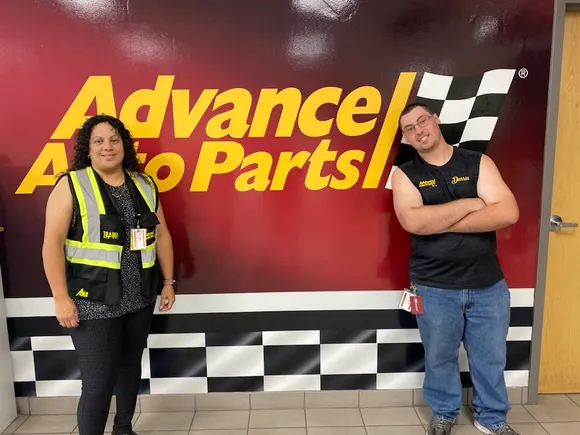
Darrin Masters, a warehouse associate at Advance Auto's Kutztown, Pennsylvania, distribution center, joined through the program in August 2020. The 22-year-old part-time employee initially handled enhanced cleaning of the facility but has since been trained for other roles, including warehouse security, and currently focuses on adjusting product inventory within the warehouse to ensure accurate locations.
"I get along great with everyone here," Masters said. "My teammates help me a lot, and I help them too."
Despite clear benefits, stigma still hinders industry expansion of hiring
Haley Moss, a neurodiversity advocate in Florida, says bias is why such programs haven't been adopted more widely. "A lot of people have had fixed ideas about what people with disabilities can and cannot do," Moss said.
Emmett notes that this bias can be particularly pronounced in the distribution and logistics industry, as such jobs often require significant physical labor and facility operators tend to be metrics-driven. "There's a stigma that 'people with disabilities can't keep up, and my numbers will go down,'" he said. "The opposite is true, especially for people with invisible disabilities."
Moss, who has autism, says that regardless of the workplace or role, the value employees with disabilities bring to companies goes far beyond public relations. Navigating a world "not designed for you" drives innovation, she says. Moss notes that people with disabilities are not a monolithic group, but if they are supported and treated well, they often show more loyalty than their non-disabled colleagues. "When someone is genuinely good to you, you value that immensely," she said.
Boosting innovation and retention by countering ableism
Natalie M. Scala, director of the supply chain graduate program at Towson University in Maryland, says companies can leverage the growing automation in distribution centers to make jobs more inclusive and accessible for people with disabilities and everyone else. "Why not?" Scala said. "We have a very pressing need right now."
Scala believes hiring people with disabilities is not just a way to fill labor gaps in the supply chain industry, but an opportunity for companies to think outside the box and match people with roles where they can thrive. Moss, meanwhile, cautions against viewing disability inclusion as a short-term fix. "This should be a long-term investment," Moss said. "Once they're integrated into your workforce, they should be a permanent part of it."

Despite the many benefits employees with disabilities bring to companies, Moss says requiring a business case to hire them overlooks a broader issue: people with disabilities are people first. "We all want to be happy," Moss said. "We want to be successful, whatever that means for us. We want to feel like we have purpose. We want to be accepted in society. For many people with disabilities and neurodivergent individuals, that means having a job, or having the ability to get a job—and even being able to leave a job and have the freedom to go elsewhere."